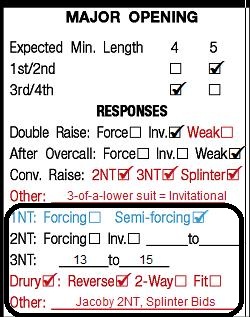
Last month we did the upper part of this section and now we focus on the encircled portion.
LC Standard uses 2/1 GF. I've written a 64-page booklet to summarize this system. At the end of this section is a check-list for a regular partnership on the 2/1 GF style in use.
1NT Response
Notice that the Semi-forcing box is checked for a 1NT response. I don't think it is a big deal as to what you label the 1NT response. Really, it is just a catch-all bid to show 6-12. Responder doesn't have enough to go to the 2-level in a new suit (in the old days, 1NT was capped at 10).
Here is a quick view of the good and bad of playing 1NT as 100% forcing. BAD: If 1NT is truly forcing, then opener must bid again. If opener has a flat minimum, he has to rebid in a 3-card minor (he can't repeat a 5-card major). Though possibly the last making contract, it is impossible to play in 1NT. GOOD: If 1NT is 100% forcing, it allows responder to later show a 3-card limit raise (by jumping to 3-of-the-major) or to bid a new suit on the 2 level to show a weakish 1-suiter.
I prefer "semi-forcing." This means that opener can (and will) pass with a flat minimum. Accordingly, if opener does bid a new suit, he is not flat (he is at least 5-4). Here is a quick view of the good and bad of playing 1NT as semi-forcing.
BAD: If responder has a weak 1-suiter, he will end up unable to show it if 1NT gets passed. Also, responder might play 1NT when he actually holds a 3-card limit raise. In my experience, that's not so bad (often 1NT makes when 3-of-the-major would have failed). GOOD: Because opener's rebid is now "real," bidding is more accurate (opener's new suit is not one of those improvised 3-carders). Also, 1NT is often the correct contract and can now be played.
So, "Semi-Forcing" is what I recommend for LC Standard. I've had 30 years observing that it is slightly better (and much simpler) than the alternative of 100% forcing. If you and your partner want to play it completely Forcing, then mark the card accordingly.
Notes: The bottom range for any 1NT response is assumed to be 6 points, but, especially at favorable vulnerability, it could be a very weak tactical action. By a passed-hand, 1NT is never forcing.
2NT Response
Jacoby 2NT is used as marked in Red (also the 2NT box is checked--as discussed last month). Assume Standard Jacoby 2NT unless your partnership wishes to take on extra memory. Jacoby 2NT is not used by a passed hand or over any interference. For an advanced system of Jacoby 2NT, click here.
3NT Response
LC Standard uses a 3NT response to show a flat 13-15 hand. Flat means 4-3-3-3. Typically, the four-card suit won't be in a major. It should be a "soft" 13-15 -- such as:  Q J 3
Q J 3
 Q 10 5
 K J 9 8
 K Q 2
K Q 2
. Don't respond 3NT with a control-rich hand such as: K 3 2
A 3 2
A 4 2
K 7 4 2
(respond 2 and later raise the major). After a 3NT response, opener can pass, but usually will convert back to his major (or make a slam try).
Passed-Hand Bidding
Reverse_Drury (nobody uses "regular" Drury) employs 2 by a passed-hand to show 3+ cards in trump and 10+ in support (counting distribution). Opener signs off in the major with a minimum. Example:
| West |
North |
East |
South |
| Pass |
Pass |
1
|
Pass |
| 2* |
Pass |
2=weak |
|
With any decent hand, opener does something other than signing off. If you wish to use 2-way Drury, make sure to discuss it and mark it accordingly (2 would show 4+ trumps and 2 would mean exactly 3 trumps). One-way Drury (reverse) is assumed in LC Standard. Drury is not used in any competition (off after double, off if there is an overcall).
A jump by a passed-hand is fit-showing (4+ trumps and values in the suit jumped into). The jump shows invitational values. So, after P-(P)-1-(P), jump to 3 with: K 10 4 3
3 2
A Q 10 8 7
4 2
. Even if the opponents interfere, the passed-hand jump is still fit-showing. The partnership must play in the major opened--they are forced back to 3-of-the-major.
Splinter Bids
A jump above 3-of-opener's major is a Splinter Bid. This includes 1-3 and 1-4. Splinter bids are assumed to be approximately 12-15 points in support (and 4+ trump). Splinter Bids are not used in Competition. They are off after a double or an overcall. Use weak jumps in competition (so 1 [2] 4 shows something like: 7 6
2
K Q 10 8 7 5 4
5 3 2).
A jump to 4-of-the opponent's suit is still (always) a splinter bid.
Game Tries
There are many fancy methods on the market, but LC Standard is simple here. A new suit after a raise is a plain-old natural game try. So, after 1-2, bid 3 with: A Q 8 7 6 2
A
K 2
Q 6 5 4
. Responder will know that high cards in clubs are useful. He will reject the game try with something like: K J 5
Q 7 6 2
Q 4 3
8 7 2
. There is an optional upgrade listed here.
In Competition
A jump raise in competition (after a double or an overcall) is weak (4+ trump and up to about 6 points in support).
All jumps in competition are weak (this isn't really my favorite way, but almost everyone plays it as weak, so I am giving in). So, after 1 (X), jump to 3 with: 8 7
Q J 10 9 8 7 2
7 6 4
2.
After 1 (1), jump to 3 with: 4
7 6
5 4 2
A J 10 7 6 5 2
.
Of course, cue-bidding the opponent's suit shows a limit raise or better. Example: 1 (2) 3.
If the opponents make a takeout double, a limit (or better) raise is shown via 2NT (Jordan). Example: 1 (X) 2NT
Note: Experienced partnerships can add "transfers" after double or some form of BROMAD covered here.
2/1 GF
Any experienced partnership will want to discuss the nuances of a 2/1 GF auction. Here is a partnership checklist to address the various treatments.
For the complete LC Standard Card and a prettier formatted version of this series, see Bridge Winners.
Extra Reading:
What Should we Play?
2/1 GF by Larry Cohen